

Table of Content
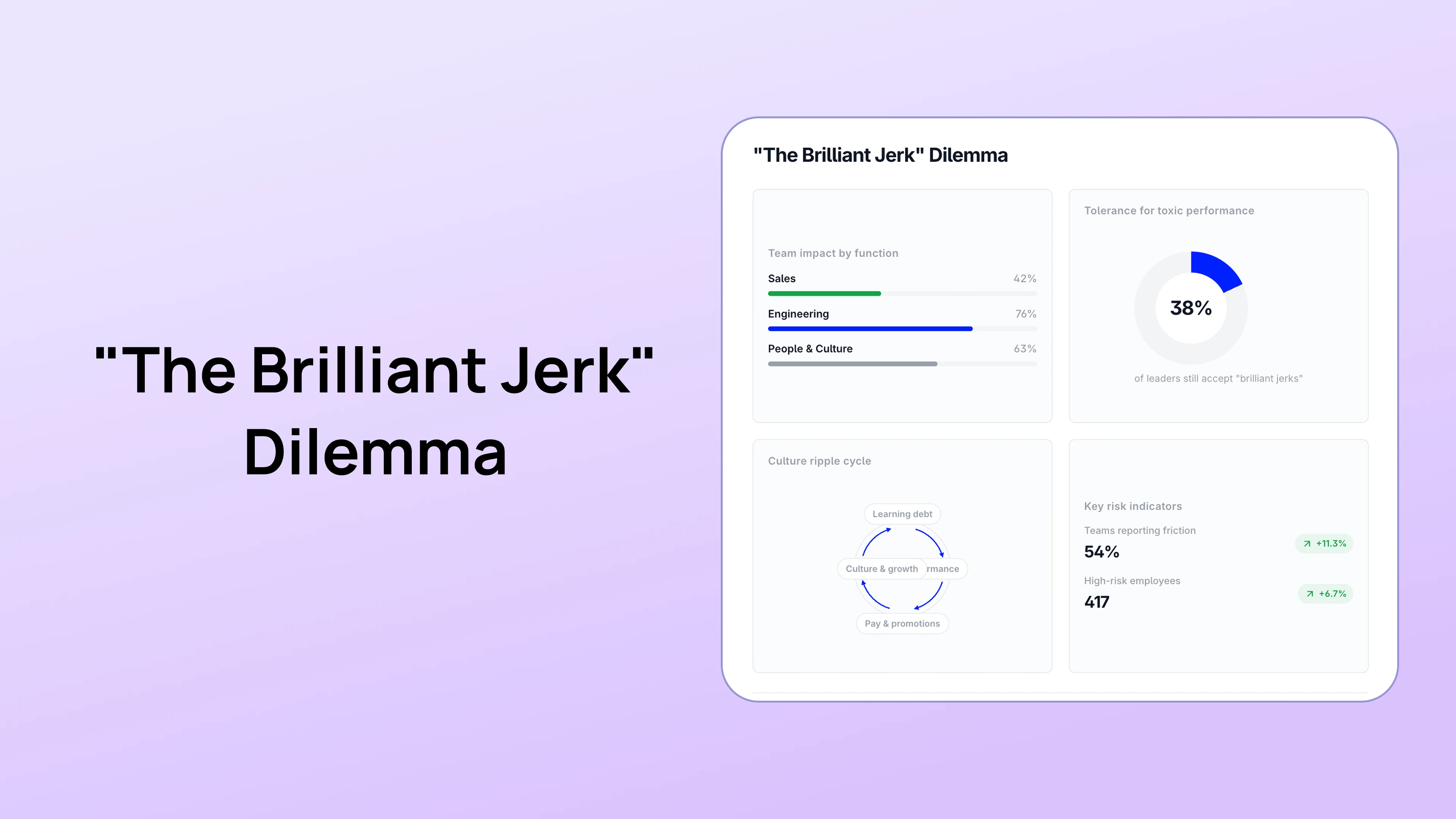
"The Brilliant Jerk" Dilemma: When High Performance Destroys Culture (And How to Fix It)
Every high-growth company eventually faces the same impossible choice.
You have an employee. Let’s call him Alex. Alex is your top engineer. He writes code 10x faster than anyone else. He saved the launch last week. He is technically a genius.
He is also impossible to work with. He belittles junior developers in code reviews. He rolls his eyes in meetings. He refuses to document his work because "it slows him down."
Alex is a Brilliant Jerk.
The CEO loves him because he delivers results. The team hates him because he destroys psychological safety.
Most management advice offers a binary solution: "Fire them immediately." This is easy to say in a blog post but terrifying to do when that person holds the keys to your product or 30% of your revenue.
In the PerformSpark Strategy, we believe you cannot simply fire your way to a great culture. You need a framework to diagnose, contain, and ultimately resolve the toxicity without crashing the business.
This guide provides the playbook for handling the Brilliant Jerk without destroying your company’s momentum.
The Hidden Math of Toxicity
The reason leaders keep Brilliant Jerks is simple: Visible Output vs. Invisible Cost.
You see the code Alex ships (Visible). You do not see the three engineers who are quietly updating their resumes because they are tired of dealing with him (Invisible).
Reed Hastings, the CEO of Netflix, famously wrote in his culture deck: "The actual company values, as opposed to the nice-sounding values, are shown by who gets rewarded, promoted, or let go."
If you promote Alex, you just told the entire company that Results > Behavior.
The Toxicity Coefficient
Research from Harvard Business School suggests that avoiding a toxic employee saves a company twice as much money as hiring a superstar generates.
- The Superstar: Adds $5,300 in value (top 1% productivity).
- The Toxic Worker: Costs $12,500 in turnover and litigation risk.
Mathematically, you are better off with an average performer than a toxic superstar. The Brilliant Jerk is a debt instrument. You get short-term cash (performance) in exchange for long-term interest (cultural decay). Eventually, the bill comes due.
Step 1: Diagnosis (Is it Competence or Character?)
Before you act, you must define the behavior. "He's annoying" is not actionable. "He violates our core values" is.
Use the Performance/Values Matrix to map your team.
- Top Right (Star): High Performance / High Values. (Clone them).
- Bottom Left (Terminator): Low Performance / Low Values. (Fire immediately).
- Bottom Right (Cheerleader): Low Performance / High Values. (Train or move roles).
- Top Left (The Jerk): High Performance / Low Values. (The Danger Zone).
The Diagnostic Questions
To confirm you have a Brilliant Jerk, ask these three questions about their impact on others:
- The Energy Drain: After a meeting with this person, does the team feel energized or drained?
- The Information Silo: Does this person hoard information to make themselves indispensable?
- The Exception Request: Do you find yourself creating "special rules" for them (e.g., "Alex doesn't have to do check-ins")?
If the answer is "Yes," you have a cultural cancer.
Step 2: The Containment Strategy (The "Cage")
You might not be able to fire them today. Maybe they are the only ones who know the legacy code. You need a Containment Strategy while you figure out the long-term fix.
Isolate the Blast Radius
If Alex is toxic in meetings, stop inviting him to meetings. Move him to an Individual Contributor (IC) role where he interacts with code, not people.
Action: Remove them from the "Critical Path" of team dependencies. Give them a standalone project (e.g., "Build the new API connector") where they can work alone.
Remove Management Duties
Never, under any circumstances, let a Brilliant Jerk manage people.
- The Trap: "He's our best coder, so he should be the Lead."
- The Reality: He will clone his toxicity. Your juniors will either quit or become just like him.
- The Fix: Create a "Principal Engineer" track that allows for status and pay increases without people management responsibilities.
Step 3: The "Ultimatum" Conversation
You cannot contain them forever. You must confront them.
Most Brilliant Jerks do not know they are jerks. They think they are "holding high standards." You must break this delusion using Radical Candor.
The Script
Use the S.B.I. Framework.
"Alex, your technical output is the best in the company. However, your behavior in code reviews is unacceptable. When you called Sarah's code 'garbage' yesterday, it shut down the conversation.
I am going to be clear: Your behavior is now capping your career here. We value the team's velocity over your individual speed. I need you to commit to fixing this dynamic. If the behavior doesn't change, we will have to part ways, regardless of your code quality."
This is the "Come to Jesus" moment. They will either:
- Deny it: "Everyone else is just soft." (Plan the exit).
- Accept it: "I didn't realize I was doing that." (Start coaching).
How TrAI Detects "Jerk" Behavior Early
You cannot be in every meeting. TrAI acts as your eyes and ears to catch toxicity before it spreads.
The Sentiment Scanner
TrAI analyzes the tone of written feedback and public Slack messages.
Flag: "User Alex consistently uses negative sentiment words (stupid, waste, broken) in public channels."
The "Feedback Black Hole"
TrAI notices when a manager stops receiving feedback.
- Insight: "No one has given Alex peer feedback in 6 months."
- Meaning: People have given up on him. Silence is the loudest signal of a Brilliant Jerk.
Step 4: The Exit (Pulling the Band-Aid)
If the coaching fails (and it often does), you must fire them.
This is the terrifying part. You worry the product will break. You worry clients will leave.
But here is what actually happens when you fire a Brilliant Jerk: The " Relief Rally."
The day after they leave, the office feels lighter. The juniors start speaking up in meetings. The "Cheerleaders" start performing better because they are not being bullied. The team's aggregate velocity actually increases because collaboration returns.
The Lesson: The Brilliant Jerk was not driving the car fast. They were driving it with the parking brake on.
Conclusion
Culture is what you tolerate.
If you keep the Brilliant Jerk, you are making a conscious decision to trade your culture for their output. You are telling your team that abuse is the price of performance.
That price is too high.
Your job as a leader is to protect the team, not the individual. By diagnosing the behavior, attempting to coach it, and being willing to fire for it, you build a culture where "Brilliant" and "Kind" are not mutually exclusive.
Book a Consultative Demo and learn how to use PerformSpark to identify and manage the cultural outliers in your org.
"The Brilliant Jerk" Dilemma: When High Performance Destroys Culture (And How to Fix It)
Every high-growth company eventually faces the same impossible choice.
You have an employee. Let’s call him Alex. Alex is your top engineer. He writes code 10x faster than anyone else. He saved the launch last week. He is technically a genius.
He is also impossible to work with. He belittles junior developers in code reviews. He rolls his eyes in meetings. He refuses to document his work because "it slows him down."
Alex is a Brilliant Jerk.
The CEO loves him because he delivers results. The team hates him because he destroys psychological safety.
Most management advice offers a binary solution: "Fire them immediately." This is easy to say in a blog post but terrifying to do when that person holds the keys to your product or 30% of your revenue.
In the PerformSpark Strategy, we believe you cannot simply fire your way to a great culture. You need a framework to diagnose, contain, and ultimately resolve the toxicity without crashing the business.
This guide provides the playbook for handling the Brilliant Jerk without destroying your company’s momentum.
The Hidden Math of Toxicity
The reason leaders keep Brilliant Jerks is simple: Visible Output vs. Invisible Cost.
You see the code Alex ships (Visible). You do not see the three engineers who are quietly updating their resumes because they are tired of dealing with him (Invisible).
Reed Hastings, the CEO of Netflix, famously wrote in his culture deck: "The actual company values, as opposed to the nice-sounding values, are shown by who gets rewarded, promoted, or let go."
If you promote Alex, you just told the entire company that Results > Behavior.
The Toxicity Coefficient
Research from Harvard Business School suggests that avoiding a toxic employee saves a company twice as much money as hiring a superstar generates.
- The Superstar: Adds $5,300 in value (top 1% productivity).
- The Toxic Worker: Costs $12,500 in turnover and litigation risk.
Mathematically, you are better off with an average performer than a toxic superstar. The Brilliant Jerk is a debt instrument. You get short-term cash (performance) in exchange for long-term interest (cultural decay). Eventually, the bill comes due.
Step 1: Diagnosis (Is it Competence or Character?)
Before you act, you must define the behavior. "He's annoying" is not actionable. "He violates our core values" is.
Use the Performance/Values Matrix to map your team.
- Top Right (Star): High Performance / High Values. (Clone them).
- Bottom Left (Terminator): Low Performance / Low Values. (Fire immediately).
- Bottom Right (Cheerleader): Low Performance / High Values. (Train or move roles).
- Top Left (The Jerk): High Performance / Low Values. (The Danger Zone).
The Diagnostic Questions
To confirm you have a Brilliant Jerk, ask these three questions about their impact on others:
- The Energy Drain: After a meeting with this person, does the team feel energized or drained?
- The Information Silo: Does this person hoard information to make themselves indispensable?
- The Exception Request: Do you find yourself creating "special rules" for them (e.g., "Alex doesn't have to do check-ins")?
If the answer is "Yes," you have a cultural cancer.
Step 2: The Containment Strategy (The "Cage")
You might not be able to fire them today. Maybe they are the only ones who know the legacy code. You need a Containment Strategy while you figure out the long-term fix.
Isolate the Blast Radius
If Alex is toxic in meetings, stop inviting him to meetings. Move him to an Individual Contributor (IC) role where he interacts with code, not people.
Action: Remove them from the "Critical Path" of team dependencies. Give them a standalone project (e.g., "Build the new API connector") where they can work alone.
Remove Management Duties
Never, under any circumstances, let a Brilliant Jerk manage people.
- The Trap: "He's our best coder, so he should be the Lead."
- The Reality: He will clone his toxicity. Your juniors will either quit or become just like him.
- The Fix: Create a "Principal Engineer" track that allows for status and pay increases without people management responsibilities.
Step 3: The "Ultimatum" Conversation
You cannot contain them forever. You must confront them.
Most Brilliant Jerks do not know they are jerks. They think they are "holding high standards." You must break this delusion using Radical Candor.
The Script
Use the S.B.I. Framework.
"Alex, your technical output is the best in the company. However, your behavior in code reviews is unacceptable. When you called Sarah's code 'garbage' yesterday, it shut down the conversation.
I am going to be clear: Your behavior is now capping your career here. We value the team's velocity over your individual speed. I need you to commit to fixing this dynamic. If the behavior doesn't change, we will have to part ways, regardless of your code quality."
This is the "Come to Jesus" moment. They will either:
- Deny it: "Everyone else is just soft." (Plan the exit).
- Accept it: "I didn't realize I was doing that." (Start coaching).
How TrAI Detects "Jerk" Behavior Early
You cannot be in every meeting. TrAI acts as your eyes and ears to catch toxicity before it spreads.
The Sentiment Scanner
TrAI analyzes the tone of written feedback and public Slack messages.
Flag: "User Alex consistently uses negative sentiment words (stupid, waste, broken) in public channels."
The "Feedback Black Hole"
TrAI notices when a manager stops receiving feedback.
- Insight: "No one has given Alex peer feedback in 6 months."
- Meaning: People have given up on him. Silence is the loudest signal of a Brilliant Jerk.
Step 4: The Exit (Pulling the Band-Aid)
If the coaching fails (and it often does), you must fire them.
This is the terrifying part. You worry the product will break. You worry clients will leave.
But here is what actually happens when you fire a Brilliant Jerk: The " Relief Rally."
The day after they leave, the office feels lighter. The juniors start speaking up in meetings. The "Cheerleaders" start performing better because they are not being bullied. The team's aggregate velocity actually increases because collaboration returns.
The Lesson: The Brilliant Jerk was not driving the car fast. They were driving it with the parking brake on.
Conclusion
Culture is what you tolerate.
If you keep the Brilliant Jerk, you are making a conscious decision to trade your culture for their output. You are telling your team that abuse is the price of performance.
That price is too high.
Your job as a leader is to protect the team, not the individual. By diagnosing the behavior, attempting to coach it, and being willing to fire for it, you build a culture where "Brilliant" and "Kind" are not mutually exclusive.
Book a Consultative Demo and learn how to use PerformSpark to identify and manage the cultural outliers in your org.




.svg)

.svg)
.svg)