

Table of Content
Closing the Growth Gap: How to Turn Review Feedback into Actionable IDPs
The most frustrating disconnect in modern Human Resources is the gap between knowing and growing.
Your performance review process likely works perfectly to identify the problem. You run a comprehensive 360-degree review cycle. You collect honest peer feedback. You analyze the data carefully. You sit down with the employee and tell them clearly that they need to improve their strategic thinking or financial acumen. The employee agrees with the feedback.
And then absolutely nothing happens.
The review is filed away in a digital folder. The feedback sits stagnant in a PDF report. Six months later, you have the exact same conversation with the same employee because no action was taken to address the skill gap.
We call this the Growth Gap. It is the distance between identifying a weakness and actually fixing it.
For most companies, the Individual Development Plan (IDP) is just a piece of paper, or worse, "shelfware" that gets filled out in January during compliance season and ignored until December. It is treated as an administrative chore rather than a strategic lever.
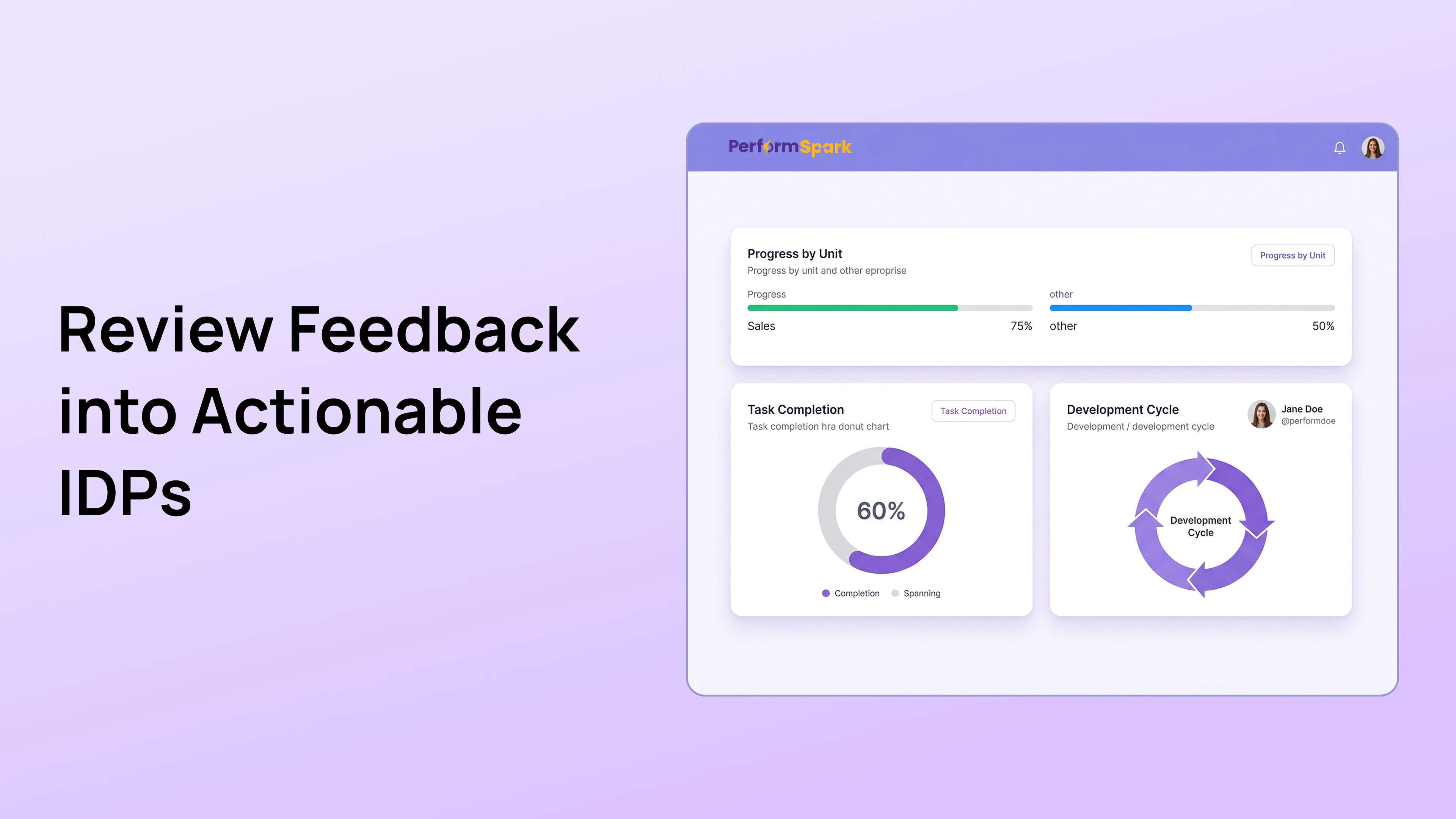
In the PerformSpark Strategy, which serves as our core methodology for data-driven HR, we believe the IDP must be dynamic, real-time, and integrated into the daily flow of work. This guide explains how to use modern technology to close the Growth Gap and turn feedback into fuel for retention
What is an Individual Development Plan (IDP)?
An Individual Development Plan (IDP) is a strategic roadmap created collaboratively by an employee and their manager to define the specific skills, knowledge, and experiences needed to achieve career goals and business objectives.
Unlike a Performance Improvement Plan (PIP), which is a disciplinary tool for underperformers with a focus on compliance and potential termination, an IDP is a retention tool for your top talent. It answers the most critical question a high performer has regarding their future at the company.
The 5 Core Differences Between Static and Dynamic IDPs
To rank for questions about "modern development plans," it is critical to distinguish between the old method and the new method.
- Frequency: Static plans are created once a year. Dynamic plans are updated quarterly or monthly.
- Source Data: Static plans rely on subjective memory. Dynamic plans use live data from Strategic 360 Reviews.
- Format: Static plans are Word Docs stored on a drive. Dynamic plans are interactive dashboards integrated with the workflow.
- Accountability: Static plans have no accountability until the next annual cycle. Dynamic plans are reviewed weekly via Manager Check-ins.
- Outcome: Static plans become Shelfware. Dynamic plans drive Career Velocity and internal mobility.
Why do traditional IDPs fail to drive growth?
Most IDPs fail because they are disconnected from the flow of work. They exist in a separate silo from the actual performance conversations and daily operations.
1. The Blank Page Problem
When you ask an employee to write a Development Plan without guidance, they freeze. They do not know what to write. They usually google generic goals like ‘Improve Communication’ or ‘Be more Strategic’ Without specific data points to guide them, the plan becomes vague, unmeasurable, and uninspiring. This lack of specificity makes it impossible to track progress later.
2. The Accountability Vacuum
A goal without a deadline is just a wish. In a traditional system, there is no mechanism to track progress on learning goals. The manager asks about revenue targets or project deadlines every single week, but they never ask about the IDP goal. This signals to the employee that learning does not actually matter to the business. If the manager does not care, the employee will prioritize other work, and the Growth Gap widens.
3. The Content Disconnect
Employees often identify a skill gap but fail to find the right resource to close it. They spend hours searching for courses or books, often giving up before they start. Without a curated path, the friction of finding learning material is too high.
How does the Golden Thread connect Feedback to Learning?
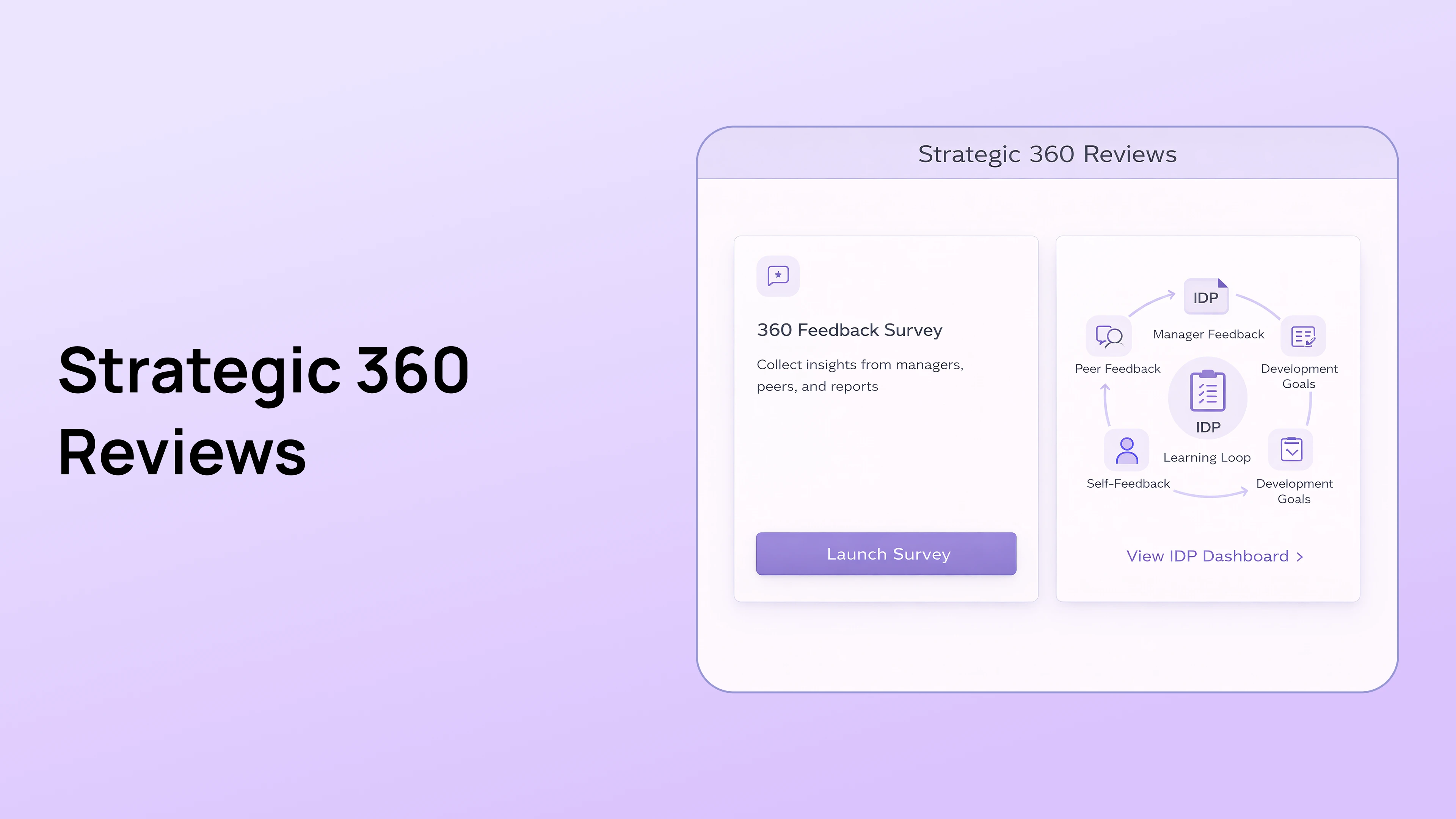
The solution to the Growth Gap is the Golden Thread. As detailed in our Performance Data Strategy, the Golden Thread is the digital architecture that connects your diagnosis tools (Reviews) to your cure tools (Learning).
The 4-Step Integrated Workflow
In PerformSpark, the IDP is not a standalone document. It is the destination for all feedback. We automate the connection between discovering a problem and solving it.
- Capture (Diagnosis): During a 360 Review cycle, a peer suggests that the employee needs to work on Financial Acumen because they struggled to manage the Q3 budget.
- Convert (Prescription): The manager does not need to copy-paste this into a new document. They click a single button labeled Add to IDP right inside the review module.
- Commit (Contract): The weakness is instantly converted into a Learning Goal in the IDP module. The employee receives a notification to accept the goal and set a due date.
- Track (Accountability): This goal now appears in the employee's Weekly Check-in. Every week, the system asks the employee what progress they made on Financial Acumen this week. This forces a continuous conversation about growth.
This ensures that feedback is never lost. It is immediately operationalized into a plan of action.
What is the 70-20-10 Model for IDPs?
To build a robust IDP, you need a framework. Simply listing three books to read is not a development plan. L&D professionals rely on the 70-20-10 Model, which states that adult learning comes from three distinct sources.
The 70–20–10 model suggests that 70% of learning comes from on-the-job experience, 20% from coaching and feedback, and 10% from formal training.
How does the TrAI Learning Engine curate content?
Even with a framework, employees often struggle to find the right resources. They do not know which course is best or who to ask for mentorship. TrAI, our ethical intelligence engine, solves this Discovery Problem by acting as a Learning Concierge.
Context-Aware Recommendations
TrAI analyzes the text of the performance review to suggest specific learning assets. It understands the nuance of language to bridge the gap between feedback and action.
- The Input: A manager writes in a review that John struggles with difficult conversations and often avoids conflict.
- The TrAI Analysis: The engine identifies the skill gap as Conflict Resolution and Stakeholder Management.
- The Output: TrAI suggests adding a goal to complete the Crucial Conversations workshop by Q2. It links directly to the content in your Learning Management System (LMS).
The Skill Graph and Predictive Growth
TrAI builds a Skill Graph for your entire organization. It looks at historical data to see what works.
- Analysis: It sees that 5 high-performing Directors all took a specific Leadership Course last year before being promoted.
- Recommendation: When a Senior Manager is promoted to Director, TrAI recommends that same course.
- Benefit: This uses organizational data to predict the best path for success, democratizing access to the unwritten rules of advancement within your company.
How to measure the ROI of IDPs?
CFOs often view L&D as a cost center. You must prove it is a profit center. You can measure the ROI of your IDP program using three hard metrics.
1. The Internal Mobility Rate
Are you hiring from within? A healthy IDP program should result in a high rate of internal promotions. If you are constantly hiring external candidates for senior roles, your development plans are failing to prepare your people.
- Metric: Percentage of open roles filled by internal candidates.
- Benchmark: Best-in-class companies aim for 40% to 50% internal mobility.
2. The Retention of High Potentials
Your Stars, those in the Top Right of the 9-Box Grid, are flight risks. They stay only if they see a future.
Metric: Retention rate of employees with active IDPs vs. those without.
Result: Data typically shows a 30% higher retention rate for employees who feel the company is investing in their growth. The cost of replacing a Star employee is often 200% of their salary, making the ROI of retention massive.
3. Skill Gap Closure Rate
Are people actually getting better? You need to measure competency growth over time.
- Metric: Track the Competency Score delta.
- Result: If an employee scored 2/5 on Strategy in Q1 and 4/5 in Q4 after completing their IDP, you have quantifiable proof of growth.
Conclusion
Talent Hoarding is the enemy of growth. Talent Development is the engine of scale.
When you treat the IDP as a compliance task, you get Shelfware. You get disengaged employees who leave for competitors that promise them a future.
When you treat it as a strategic asset, powered by TrAI, structured by the 70-20-10 Model, and connected by the Golden Thread, you close the Growth Gap. You create a culture where feedback is not just heard but acted upon.
You stop renting talent and start building it.
Book a Consultative Demo and see how PerformSpark turns Feedback into Actionable Growth.
Closing the Growth Gap: How to Turn Review Feedback into Actionable IDPs
The most frustrating disconnect in modern Human Resources is the gap between knowing and growing.
Your performance review process likely works perfectly to identify the problem. You run a comprehensive 360-degree review cycle. You collect honest peer feedback. You analyze the data carefully. You sit down with the employee and tell them clearly that they need to improve their strategic thinking or financial acumen. The employee agrees with the feedback.
And then absolutely nothing happens.
The review is filed away in a digital folder. The feedback sits stagnant in a PDF report. Six months later, you have the exact same conversation with the same employee because no action was taken to address the skill gap.
We call this the Growth Gap. It is the distance between identifying a weakness and actually fixing it.
For most companies, the Individual Development Plan (IDP) is just a piece of paper, or worse, "shelfware" that gets filled out in January during compliance season and ignored until December. It is treated as an administrative chore rather than a strategic lever.
In the PerformSpark Strategy, which serves as our core methodology for data-driven HR, we believe the IDP must be dynamic, real-time, and integrated into the daily flow of work. This guide explains how to use modern technology to close the Growth Gap and turn feedback into fuel for retention
What is an Individual Development Plan (IDP)?
An Individual Development Plan (IDP) is a strategic roadmap created collaboratively by an employee and their manager to define the specific skills, knowledge, and experiences needed to achieve career goals and business objectives.
Unlike a Performance Improvement Plan (PIP), which is a disciplinary tool for underperformers with a focus on compliance and potential termination, an IDP is a retention tool for your top talent. It answers the most critical question a high performer has regarding their future at the company.
The 5 Core Differences Between Static and Dynamic IDPs
To rank for questions about "modern development plans," it is critical to distinguish between the old method and the new method.
- Frequency: Static plans are created once a year. Dynamic plans are updated quarterly or monthly.
- Source Data: Static plans rely on subjective memory. Dynamic plans use live data from Strategic 360 Reviews.
- Format: Static plans are Word Docs stored on a drive. Dynamic plans are interactive dashboards integrated with the workflow.
- Accountability: Static plans have no accountability until the next annual cycle. Dynamic plans are reviewed weekly via Manager Check-ins.
- Outcome: Static plans become Shelfware. Dynamic plans drive Career Velocity and internal mobility.
Why do traditional IDPs fail to drive growth?
Most IDPs fail because they are disconnected from the flow of work. They exist in a separate silo from the actual performance conversations and daily operations.
1. The Blank Page Problem
When you ask an employee to write a Development Plan without guidance, they freeze. They do not know what to write. They usually google generic goals like ‘Improve Communication’ or ‘Be more Strategic’ Without specific data points to guide them, the plan becomes vague, unmeasurable, and uninspiring. This lack of specificity makes it impossible to track progress later.
2. The Accountability Vacuum
A goal without a deadline is just a wish. In a traditional system, there is no mechanism to track progress on learning goals. The manager asks about revenue targets or project deadlines every single week, but they never ask about the IDP goal. This signals to the employee that learning does not actually matter to the business. If the manager does not care, the employee will prioritize other work, and the Growth Gap widens.
3. The Content Disconnect
Employees often identify a skill gap but fail to find the right resource to close it. They spend hours searching for courses or books, often giving up before they start. Without a curated path, the friction of finding learning material is too high.
How does the Golden Thread connect Feedback to Learning?
The solution to the Growth Gap is the Golden Thread. As detailed in our Performance Data Strategy, the Golden Thread is the digital architecture that connects your diagnosis tools (Reviews) to your cure tools (Learning).
The 4-Step Integrated Workflow
In PerformSpark, the IDP is not a standalone document. It is the destination for all feedback. We automate the connection between discovering a problem and solving it.
- Capture (Diagnosis): During a 360 Review cycle, a peer suggests that the employee needs to work on Financial Acumen because they struggled to manage the Q3 budget.
- Convert (Prescription): The manager does not need to copy-paste this into a new document. They click a single button labeled Add to IDP right inside the review module.
- Commit (Contract): The weakness is instantly converted into a Learning Goal in the IDP module. The employee receives a notification to accept the goal and set a due date.
- Track (Accountability): This goal now appears in the employee's Weekly Check-in. Every week, the system asks the employee what progress they made on Financial Acumen this week. This forces a continuous conversation about growth.
This ensures that feedback is never lost. It is immediately operationalized into a plan of action.
What is the 70-20-10 Model for IDPs?
To build a robust IDP, you need a framework. Simply listing three books to read is not a development plan. L&D professionals rely on the 70-20-10 Model, which states that adult learning comes from three distinct sources.
The 70–20–10 model suggests that 70% of learning comes from on-the-job experience, 20% from coaching and feedback, and 10% from formal training.
How does the TrAI Learning Engine curate content?
Even with a framework, employees often struggle to find the right resources. They do not know which course is best or who to ask for mentorship. TrAI, our ethical intelligence engine, solves this Discovery Problem by acting as a Learning Concierge.
Context-Aware Recommendations
TrAI analyzes the text of the performance review to suggest specific learning assets. It understands the nuance of language to bridge the gap between feedback and action.
- The Input: A manager writes in a review that John struggles with difficult conversations and often avoids conflict.
- The TrAI Analysis: The engine identifies the skill gap as Conflict Resolution and Stakeholder Management.
- The Output: TrAI suggests adding a goal to complete the Crucial Conversations workshop by Q2. It links directly to the content in your Learning Management System (LMS).
The Skill Graph and Predictive Growth
TrAI builds a Skill Graph for your entire organization. It looks at historical data to see what works.
- Analysis: It sees that 5 high-performing Directors all took a specific Leadership Course last year before being promoted.
- Recommendation: When a Senior Manager is promoted to Director, TrAI recommends that same course.
- Benefit: This uses organizational data to predict the best path for success, democratizing access to the unwritten rules of advancement within your company.
How to measure the ROI of IDPs?
CFOs often view L&D as a cost center. You must prove it is a profit center. You can measure the ROI of your IDP program using three hard metrics.
1. The Internal Mobility Rate
Are you hiring from within? A healthy IDP program should result in a high rate of internal promotions. If you are constantly hiring external candidates for senior roles, your development plans are failing to prepare your people.
- Metric: Percentage of open roles filled by internal candidates.
- Benchmark: Best-in-class companies aim for 40% to 50% internal mobility.
2. The Retention of High Potentials
Your Stars, those in the Top Right of the 9-Box Grid, are flight risks. They stay only if they see a future.
Metric: Retention rate of employees with active IDPs vs. those without.
Result: Data typically shows a 30% higher retention rate for employees who feel the company is investing in their growth. The cost of replacing a Star employee is often 200% of their salary, making the ROI of retention massive.
3. Skill Gap Closure Rate
Are people actually getting better? You need to measure competency growth over time.
- Metric: Track the Competency Score delta.
- Result: If an employee scored 2/5 on Strategy in Q1 and 4/5 in Q4 after completing their IDP, you have quantifiable proof of growth.
Conclusion
Talent Hoarding is the enemy of growth. Talent Development is the engine of scale.
When you treat the IDP as a compliance task, you get Shelfware. You get disengaged employees who leave for competitors that promise them a future.
When you treat it as a strategic asset, powered by TrAI, structured by the 70-20-10 Model, and connected by the Golden Thread, you close the Growth Gap. You create a culture where feedback is not just heard but acted upon.
You stop renting talent and start building it.
Book a Consultative Demo and see how PerformSpark turns Feedback into Actionable Growth.




.svg)

.svg)
.svg)