


Table of Content
How to Measure Employee Performance: Methods, Metrics, and Best Practices (2026)
What does it mean to measure employee performance?
- Measuring employee performance means systematically evaluating how well an employee meets their role expectations, achieves their goals, and demonstrates the behaviors and competencies that drive team and organizational outcomes. Effective measurement combines quantitative data (goal completion, output metrics, quality indicators) with qualitative assessment (behavioral observation, 360 feedback, manager judgment) to produce a complete, accurate, and defensible picture of an employee's contribution.
Key Takeaways
- Companies that focus on their people's performance are 4.2 times more likely to outperform their peers, with 30% higher revenue growth on average (McKinsey via People Managing People, 2025).
- Performance measurement works best when it combines quantitative metrics (what was produced) with qualitative assessment (how it was produced), neither alone provides a complete picture.
- The four measurement categories every organization should use: work quality, work quantity, work efficiency, and organizational impact/engagement.
- 92% of employees prefer receiving feedback more than once a year, continuous measurement and feedback outperforms point-in-time annual assessment on almost every retention and performance metric (Workhuman, 2025).
- Recency bias is the single most common measurement failure: managers weight the last few weeks disproportionately unless they document performance continuously throughout the year.
Performance measurement is the foundation of performance management. Without a consistent, fair, and documented way of evaluating how employees are performing, every downstream decision, compensation, promotion, development, corrective action, is built on guesswork.
But most organizations measure performance inconsistently, subjectively, or only at year-end, which produces ratings that reflect manager memory more than employee reality. This guide covers the methods, metrics, and practices that make performance measurement accurate, fair, and useful, for both the employee and the organization.
The Four Categories of Employee Performance Measurement
Effective performance measurement covers four complementary dimensions of contribution:
1. Work quality
Work quality metrics assess the caliber of what an employee produces, accuracy, completeness, adherence to standards, and client or stakeholder satisfaction with outputs. Quality is often harder to measure than quantity, but it is rarely unmeasurable.
- Error rate or defect rate, number of errors per defined output unit.
- Rework rate, percentage of work that requires revision after completion.
- Client or stakeholder satisfaction scores, NPS, CSAT, or structured feedback from internal or external customers.
- Quality audits, structured review of work samples against a defined standard.
2. Work quantity
Work quantity metrics track the volume of output produced in a defined time period. These are the easiest metrics to measure and the most prone to being gamed when used in isolation, which is why they must always be paired with quality indicators.
- Tasks or projects completed per period.
- Revenue or pipeline generated (for sales roles).
- Tickets resolved or cases closed (for support roles).
- Features shipped or story points completed (for engineering roles).
3. Work efficiency
Efficiency metrics evaluate how well an employee uses time and resources to produce outcomes. They capture the relationship between input (effort, time, cost) and output (results, value, revenue).
- Time to completion versus estimated time, how often work is delivered on schedule.
- Revenue per employee or profit per FTE, useful at team or department level.
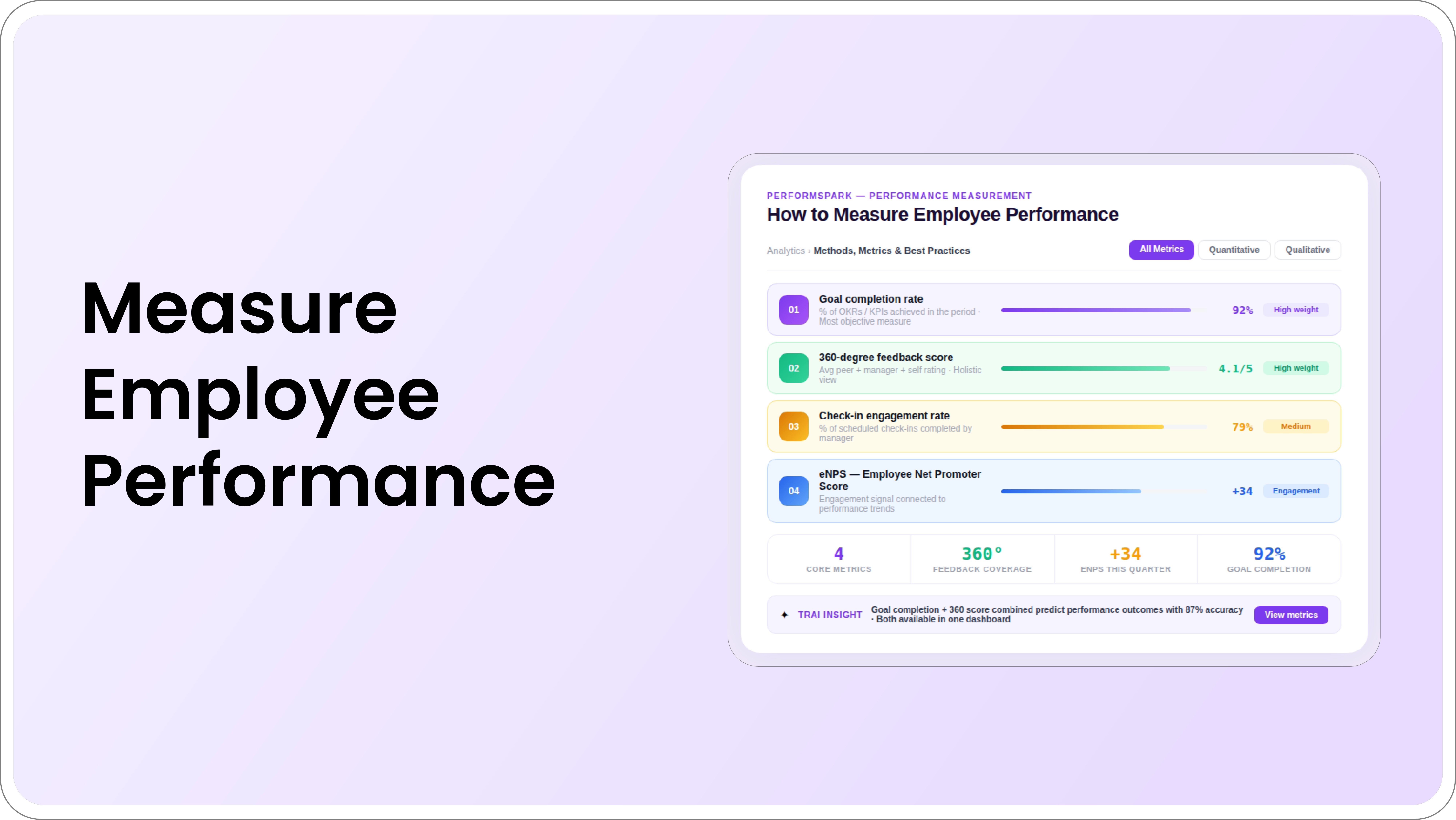
- Goal completion rate, percentage of defined goals achieved in the review period.
4. Organizational impact and engagement
These metrics capture the ripple effects of an employee's contribution beyond their individual output, team collaboration, knowledge sharing, mentoring, and engagement with the organization's culture and values.
- Employee engagement scores, how the employee rates their own engagement and the team's health.
- 360-degree feedback scores, how peers, direct reports, and cross-functional partners rate the employee's collaboration, leadership, and communication.
- Manager effectiveness metrics (for people managers), team engagement scores, team retention rate, direct report development plan completion.
Measurement Methods: Quantitative and Qualitative
Quantitative methods
Quantitative methods produce numerical data that can be compared across time periods and across employees at the same level. They are most useful for roles with clear, measurable outputs.
- KPIs: Role-specific metrics with defined targets, data sources, and review cadences. The most direct quantitative measurement method for most roles.
- OKRs: Goal progress tracked on a 0.0-1.0 scale. Particularly useful for roles or projects where the outcome is complex and no single KPI captures it adequately.
- MBO (Management by Objectives): Employee and manager agree on specific objectives at the start of the period; performance is evaluated against achievement of those objectives.
- Rating scales: Numerical or categorical scales (1-5, Strongly Disagree to Strongly Agree) applied to competency-based evaluation. Consistent across employees when properly anchored with behavioral descriptors.
Qualitative methods
Qualitative methods capture dimensions of performance that numbers alone cannot describe, behavioral impact, collaboration quality, leadership effectiveness, and contextual factors.
- Behavioral observation and documentation: Manager notes from check-ins and observations, documented close to the events they describe. This is the primary qualitative evidence base for formal reviews.
- 360-degree feedback: Multi-rater input from peers, direct reports, and cross-functional partners. Most useful for assessing behavioral competencies that the manager cannot directly observe.
- Self-assessment: Employee's own evaluation of their performance and contribution. Surfaces context the manager may not have and increases employee engagement in the review process.
- BARS (Behaviorally Anchored Rating Scale): Competency ratings grounded in specific behavioral descriptors at each level. Reduces rater subjectivity by tying scores to observable behaviors rather than general impressions.
How to Choose the Right Metrics for Each Role
No single set of metrics applies to every role. The right measurement framework for a software engineer is different from the right one for a customer success manager or an HR business partner. Three principles guide metric selection:
- Relevance to role outcomes. Metrics should track what the role is actually responsible for producing. A customer success manager should be measured on retention rate and expansion revenue, not on call volume that does not connect to these outcomes.
- Measurability without gaming. A metric that can be easily gamed by hitting a number without producing the underlying outcome it is supposed to measure is worse than no metric. Combine output metrics with quality and impact metrics to prevent this.
- Balance of quantity and quality. Every role that has quantity metrics should also have quality metrics. Volume without quality is not performance, it is activity.
The Most Common Measurement Mistakes
Recency bias
Managers write reviews from memory, and memory is recency-biased. The last four to six weeks of a review period are disproportionately weighted relative to the first eight months. The fix is continuous documentation, check-in notes, feedback records, and goal progress updates throughout the year, so that the review is written from a documented record, not from memory.
Measuring activity instead of outcomes
Hours worked, emails sent, meetings attended, and tasks logged are activity metrics, not performance metrics. They measure effort and presence, not contribution or impact. Always define performance criteria as outcomes, what was produced, what changed, what improved, rather than activities.
Inconsistent rating standards across managers
Without calibration, the same level of performance receives different ratings depending on which manager is assessing it. An employee who would receive an 'Exceeds Expectations' from one manager might receive 'Meets Expectations' from another. Calibration sessions that compare rating distributions across managers and align on standards before ratings drive compensation decisions are the primary defense against this.
Using only one method
Quantitative-only measurement misses behavioral and collaborative dimensions of performance. Qualitative-only measurement is too subjective to be defensible or comparable. Effective measurement combines both, using quantitative data to ground ratings in documented reality and qualitative assessment to capture dimensions that numbers cannot describe.
Making Performance Measurement Defensible
A performance rating is defensible when it can be supported by specific, documented evidence that a reasonable observer would agree reflects the rating. Three practices make ratings defensible:
- Document continuously, not just at review time. Check-in notes, feedback records, and goal progress updates throughout the year create the evidence base that supports year-end ratings.
- Use behavioral examples, not personality judgments. 'Delivered the Q3 analysis report three days ahead of schedule with no revision requests' is defensible. 'Is a strong performer' is not.
- Calibrate before ratings drive decisions. Ratings that have been compared against peer ratings, discussed in a structured calibration session, and adjusted for consistency before they drive compensation decisions are significantly more defensible than uncalibrated individual manager assessments.
Measure Performance With Evidence, Not Memory
PerformSpark's continuous check-in documentation, goal tracking, and AI-assisted calibration give HR teams the data they need to make performance ratings accurate, fair, and defensible, at $6/user/month. Book a Demo
How to Measure Employee Performance: Methods, Metrics, and Best Practices (2026)
What does it mean to measure employee performance?
- Measuring employee performance means systematically evaluating how well an employee meets their role expectations, achieves their goals, and demonstrates the behaviors and competencies that drive team and organizational outcomes. Effective measurement combines quantitative data (goal completion, output metrics, quality indicators) with qualitative assessment (behavioral observation, 360 feedback, manager judgment) to produce a complete, accurate, and defensible picture of an employee's contribution.
Key Takeaways
- Companies that focus on their people's performance are 4.2 times more likely to outperform their peers, with 30% higher revenue growth on average (McKinsey via People Managing People, 2025).
- Performance measurement works best when it combines quantitative metrics (what was produced) with qualitative assessment (how it was produced), neither alone provides a complete picture.
- The four measurement categories every organization should use: work quality, work quantity, work efficiency, and organizational impact/engagement.
- 92% of employees prefer receiving feedback more than once a year, continuous measurement and feedback outperforms point-in-time annual assessment on almost every retention and performance metric (Workhuman, 2025).
- Recency bias is the single most common measurement failure: managers weight the last few weeks disproportionately unless they document performance continuously throughout the year.
Performance measurement is the foundation of performance management. Without a consistent, fair, and documented way of evaluating how employees are performing, every downstream decision, compensation, promotion, development, corrective action, is built on guesswork.
But most organizations measure performance inconsistently, subjectively, or only at year-end, which produces ratings that reflect manager memory more than employee reality. This guide covers the methods, metrics, and practices that make performance measurement accurate, fair, and useful, for both the employee and the organization.
The Four Categories of Employee Performance Measurement
Effective performance measurement covers four complementary dimensions of contribution:
1. Work quality
Work quality metrics assess the caliber of what an employee produces, accuracy, completeness, adherence to standards, and client or stakeholder satisfaction with outputs. Quality is often harder to measure than quantity, but it is rarely unmeasurable.
- Error rate or defect rate, number of errors per defined output unit.
- Rework rate, percentage of work that requires revision after completion.
- Client or stakeholder satisfaction scores, NPS, CSAT, or structured feedback from internal or external customers.
- Quality audits, structured review of work samples against a defined standard.
2. Work quantity
Work quantity metrics track the volume of output produced in a defined time period. These are the easiest metrics to measure and the most prone to being gamed when used in isolation, which is why they must always be paired with quality indicators.
- Tasks or projects completed per period.
- Revenue or pipeline generated (for sales roles).
- Tickets resolved or cases closed (for support roles).
- Features shipped or story points completed (for engineering roles).
3. Work efficiency
Efficiency metrics evaluate how well an employee uses time and resources to produce outcomes. They capture the relationship between input (effort, time, cost) and output (results, value, revenue).
- Time to completion versus estimated time, how often work is delivered on schedule.
- Revenue per employee or profit per FTE, useful at team or department level.
- Goal completion rate, percentage of defined goals achieved in the review period.
4. Organizational impact and engagement
These metrics capture the ripple effects of an employee's contribution beyond their individual output, team collaboration, knowledge sharing, mentoring, and engagement with the organization's culture and values.
- Employee engagement scores, how the employee rates their own engagement and the team's health.
- 360-degree feedback scores, how peers, direct reports, and cross-functional partners rate the employee's collaboration, leadership, and communication.
- Manager effectiveness metrics (for people managers), team engagement scores, team retention rate, direct report development plan completion.
Measurement Methods: Quantitative and Qualitative
Quantitative methods
Quantitative methods produce numerical data that can be compared across time periods and across employees at the same level. They are most useful for roles with clear, measurable outputs.
- KPIs: Role-specific metrics with defined targets, data sources, and review cadences. The most direct quantitative measurement method for most roles.
- OKRs: Goal progress tracked on a 0.0-1.0 scale. Particularly useful for roles or projects where the outcome is complex and no single KPI captures it adequately.
- MBO (Management by Objectives): Employee and manager agree on specific objectives at the start of the period; performance is evaluated against achievement of those objectives.
- Rating scales: Numerical or categorical scales (1-5, Strongly Disagree to Strongly Agree) applied to competency-based evaluation. Consistent across employees when properly anchored with behavioral descriptors.
Qualitative methods
Qualitative methods capture dimensions of performance that numbers alone cannot describe, behavioral impact, collaboration quality, leadership effectiveness, and contextual factors.
- Behavioral observation and documentation: Manager notes from check-ins and observations, documented close to the events they describe. This is the primary qualitative evidence base for formal reviews.
- 360-degree feedback: Multi-rater input from peers, direct reports, and cross-functional partners. Most useful for assessing behavioral competencies that the manager cannot directly observe.
- Self-assessment: Employee's own evaluation of their performance and contribution. Surfaces context the manager may not have and increases employee engagement in the review process.
- BARS (Behaviorally Anchored Rating Scale): Competency ratings grounded in specific behavioral descriptors at each level. Reduces rater subjectivity by tying scores to observable behaviors rather than general impressions.
How to Choose the Right Metrics for Each Role
No single set of metrics applies to every role. The right measurement framework for a software engineer is different from the right one for a customer success manager or an HR business partner. Three principles guide metric selection:
- Relevance to role outcomes. Metrics should track what the role is actually responsible for producing. A customer success manager should be measured on retention rate and expansion revenue, not on call volume that does not connect to these outcomes.
- Measurability without gaming. A metric that can be easily gamed by hitting a number without producing the underlying outcome it is supposed to measure is worse than no metric. Combine output metrics with quality and impact metrics to prevent this.
- Balance of quantity and quality. Every role that has quantity metrics should also have quality metrics. Volume without quality is not performance, it is activity.
The Most Common Measurement Mistakes
Recency bias
Managers write reviews from memory, and memory is recency-biased. The last four to six weeks of a review period are disproportionately weighted relative to the first eight months. The fix is continuous documentation, check-in notes, feedback records, and goal progress updates throughout the year, so that the review is written from a documented record, not from memory.
Measuring activity instead of outcomes
Hours worked, emails sent, meetings attended, and tasks logged are activity metrics, not performance metrics. They measure effort and presence, not contribution or impact. Always define performance criteria as outcomes, what was produced, what changed, what improved, rather than activities.
Inconsistent rating standards across managers
Without calibration, the same level of performance receives different ratings depending on which manager is assessing it. An employee who would receive an 'Exceeds Expectations' from one manager might receive 'Meets Expectations' from another. Calibration sessions that compare rating distributions across managers and align on standards before ratings drive compensation decisions are the primary defense against this.
Using only one method
Quantitative-only measurement misses behavioral and collaborative dimensions of performance. Qualitative-only measurement is too subjective to be defensible or comparable. Effective measurement combines both, using quantitative data to ground ratings in documented reality and qualitative assessment to capture dimensions that numbers cannot describe.
Making Performance Measurement Defensible
A performance rating is defensible when it can be supported by specific, documented evidence that a reasonable observer would agree reflects the rating. Three practices make ratings defensible:
- Document continuously, not just at review time. Check-in notes, feedback records, and goal progress updates throughout the year create the evidence base that supports year-end ratings.
- Use behavioral examples, not personality judgments. 'Delivered the Q3 analysis report three days ahead of schedule with no revision requests' is defensible. 'Is a strong performer' is not.
- Calibrate before ratings drive decisions. Ratings that have been compared against peer ratings, discussed in a structured calibration session, and adjusted for consistency before they drive compensation decisions are significantly more defensible than uncalibrated individual manager assessments.
Measure Performance With Evidence, Not Memory
PerformSpark's continuous check-in documentation, goal tracking, and AI-assisted calibration give HR teams the data they need to make performance ratings accurate, fair, and defensible, at $6/user/month. Book a Demo
.webp)
.webp)
.webp)




.svg)

.svg)
.svg)