

Table of Content
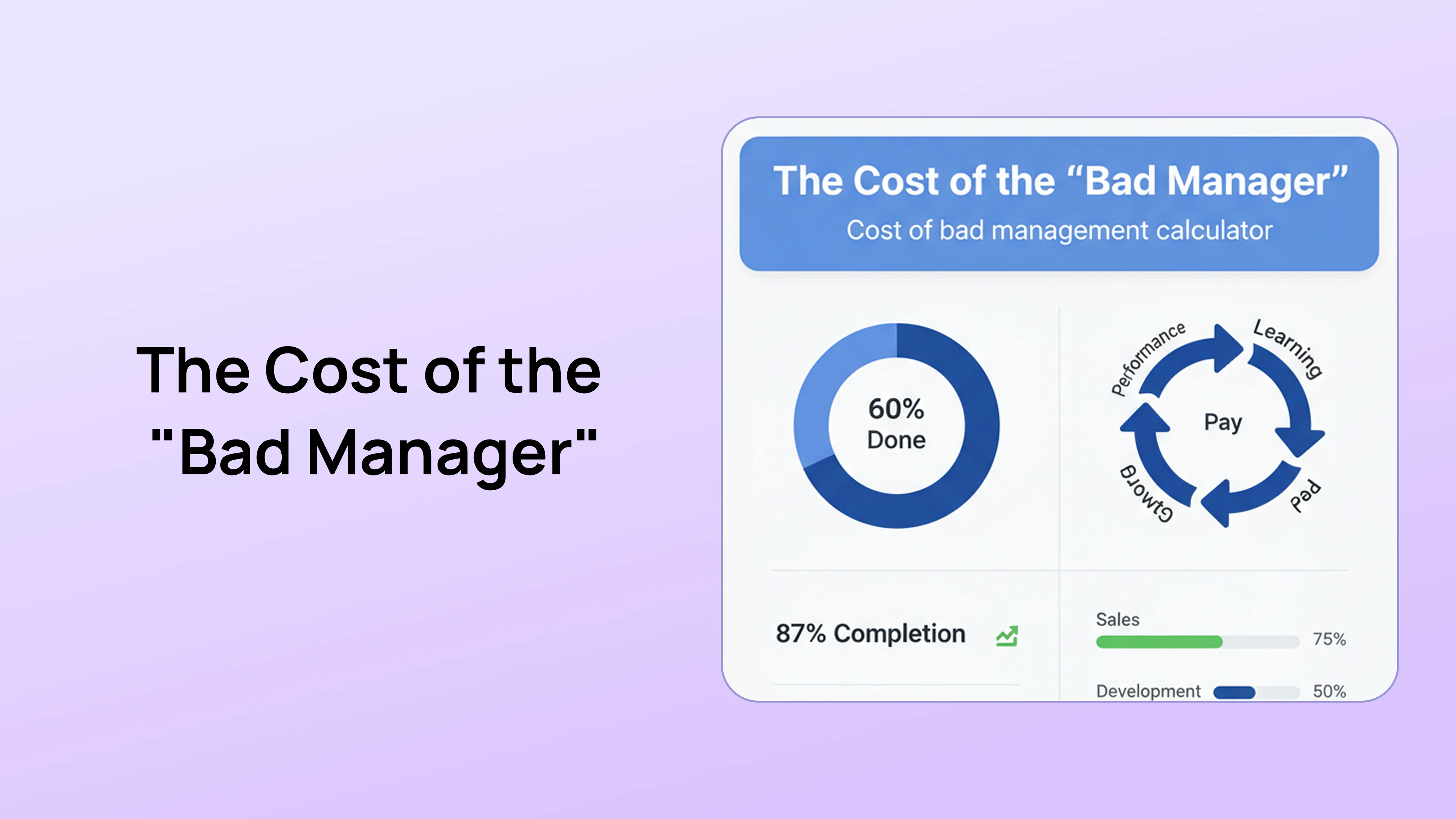
The Cost of the "Bad Manager": Calculating the Real ROI of Manager Enablement
There is a saying in HR that people join companies but leave managers. While this sounds like a soft cultural observation, it is actually a hard financial reality that is bleeding your balance sheet dry.
Most organizations view "Manager Training" as a nice-to-have perk. They assume that if they promote their best engineer to Engineering Manager, that person will naturally figure out how to lead.
They rarely do.
Instead, you get the "Accidental Manager." This is a high performer who is struggling to cope with the demands of leadership. Their team becomes disengaged.
Deadlines slip. And eventually, your top talent quits.
In the PerformSpark Strategy, we treat management not as a soft skill but as a measurable operational asset. A bad manager is a liability, just like a server outage or a lawsuit.
This guide provides the mathematical framework to calculate exactly how much ineffective leadership is costing you and how to prove the ROI of fixing it.
The Hidden Tax on Your P&L
The reason bad management persists is that it does not appear as a line item on the Profit & Loss statement.
When a server crashes, you see the lost revenue immediately. When a manager fails, the cost is hidden in "General & Administrative" expenses under recruitment fees, severance, and lost productivity.
We call this the Inefficiency Tax.
Research suggests that a single toxic or incompetent manager can cost a company 1.5x to 2x the annual salary of every employee who quits because of them.
If a manager leads a team of 10 people earning $100,000 each, and they drive two of them to quit this year, that manager has cost the business $300,000. That is likely more than the manager's own salary.
The 3 Drivers of Cost (The Formula)
To build a business case for Manager Enablement Tools, you need to break this cost down into three specific variables: Turnover, Productivity, and Opportunity Cost.
Variable 1: The Replacement Cost (Turnover)
This is the most direct cost. When an employee quits, you pay to replace them.
Recruitment Fees: 20% of salary to a headhunter.
- Onboarding Time: 3 months of paying a new hire while they ramp up to full productivity.
- Vacancy Cost: The work that does not get done while the seat is empty.
The Math:
For an employee making $120,000, the replacement cost is conservatively $60,000. If a bad manager burns out 3 people a year, that is **$180,000 in pure waste**.
Variable 2: The Engagement Gap (Productivity)
Gallup data shows that managers account for 70% of the variance in employee engagement. A disengaged employee is not necessarily quitting, but they are "Quiet Quitting."
They work at 60% capacity. They do not volunteer for new projects. They do not innovate.
The Math:
If a team of 10 is working at 60% capacity due to poor goal setting, you are effectively paying for 10 people but getting the output of 6. You are incinerating 40% of your payroll for that department. Using our Goals Management Software to align these teams can recover that lost 40%.
Variable 3: The Talent Repulsion (Opportunity)
High performers talk. If a specific manager has a reputation for being a micromanager or a "credit stealer," your internal talent market freezes.
High potential employees from other departments will refuse to transfer to that team. You end up with "Talent Ghettos" where only low performers are willing to work. This destroys innovation and eventually kills the product line that the manager is responsible for.
How to Identify the "Bad Manager" Before It Is Too Late
Most companies wait for the Exit Interview to find out a manager is toxic. By then, the damage is done. You need leading indicators.
Indicator 1: The "Skip-Level" Silence
In your 1-on-1 Meetings, ask employees about their manager. If they give vague, non-committal answers, it is a red flag. Fear creates silence.
Indicator 2: The "Sick Day" Spike
Disengagement often manifests as physical illness. If a specific team has a 30% higher rate of absenteeism than the rest of the company, look at the leader, not the flu season.
Indicator 3: The "TrAI" Sentiment Analysis
Our TrAI Engine (Redirect to: Product Feature Page) scans the sentiment of feedback given by the manager.
- Positive Manager: Uses words like "Growth," "Opportunity," "Thanks."
- Negative Manager: Uses words like "Wrong," "Failed," "Disappointed."
- TrAI flags managers who have a negative feedback ratio so HR can intervene with coaching before the team quits.
The Solution: Train, Don't Fire
The knee-jerk reaction is to fire the bad manager. This is often a mistake.
Most "bad" managers are not bad people. They are unsupported. They were promoted because they were great individual contributors, then abandoned without a handbook.
You can fix this with a Manager Enablement Strategy.
- Automate the Nudge: Use The Nudge Engine to remind them to hold 1-on-1s.
- Script the Hard Stuff: Give them the Feedback Scripts so they don't have to improvise.
- Clarify the Role: Make sure they know their job is no longer "doing the work" but "unblocking the team."
Building the CFO Slide Deck
When you go to your CFO to ask for a budget for PerformSpark, do not talk about "culture." Talk about "Risk Mitigation."
Slide 1: The Problem
"We have 5 managers with attrition rates double the company average."
Slide 2: The Cost
"These 5 managers cost us $900,000 in replacement fees last year."
Slide 3: The Solution
"Implementing PerformSpark costs $X. If we save just one high performer from quitting, the software pays for itself."
This is how you shift the conversation from "HR Cost Center" to "Operational Investment."
Conclusion
The most expensive person in your company is an untrained manager.
They are the gatekeepers of your productivity and the guardians of your retention. If you leave them to "figure it out," you are gambling with your payroll.
By quantifying the cost of bad management, you make the business case undeniable. Investing in tools that support your leaders is not just about making people feel good. It is about stopping the cash bleed caused by turnover and disengagement.
Book a Consultative Demo and let us show you how to identify your "at-risk" teams before they resign.
The Cost of the "Bad Manager": Calculating the Real ROI of Manager Enablement
There is a saying in HR that people join companies but leave managers. While this sounds like a soft cultural observation, it is actually a hard financial reality that is bleeding your balance sheet dry.
Most organizations view "Manager Training" as a nice-to-have perk. They assume that if they promote their best engineer to Engineering Manager, that person will naturally figure out how to lead.
They rarely do.
Instead, you get the "Accidental Manager." This is a high performer who is struggling to cope with the demands of leadership. Their team becomes disengaged.
Deadlines slip. And eventually, your top talent quits.
In the PerformSpark Strategy, we treat management not as a soft skill but as a measurable operational asset. A bad manager is a liability, just like a server outage or a lawsuit.
This guide provides the mathematical framework to calculate exactly how much ineffective leadership is costing you and how to prove the ROI of fixing it.
The Hidden Tax on Your P&L
The reason bad management persists is that it does not appear as a line item on the Profit & Loss statement.
When a server crashes, you see the lost revenue immediately. When a manager fails, the cost is hidden in "General & Administrative" expenses under recruitment fees, severance, and lost productivity.
We call this the Inefficiency Tax.
Research suggests that a single toxic or incompetent manager can cost a company 1.5x to 2x the annual salary of every employee who quits because of them.
If a manager leads a team of 10 people earning $100,000 each, and they drive two of them to quit this year, that manager has cost the business $300,000. That is likely more than the manager's own salary.
The 3 Drivers of Cost (The Formula)
To build a business case for Manager Enablement Tools, you need to break this cost down into three specific variables: Turnover, Productivity, and Opportunity Cost.
Variable 1: The Replacement Cost (Turnover)
This is the most direct cost. When an employee quits, you pay to replace them.
Recruitment Fees: 20% of salary to a headhunter.
- Onboarding Time: 3 months of paying a new hire while they ramp up to full productivity.
- Vacancy Cost: The work that does not get done while the seat is empty.
The Math:
For an employee making $120,000, the replacement cost is conservatively $60,000. If a bad manager burns out 3 people a year, that is **$180,000 in pure waste**.
Variable 2: The Engagement Gap (Productivity)
Gallup data shows that managers account for 70% of the variance in employee engagement. A disengaged employee is not necessarily quitting, but they are "Quiet Quitting."
They work at 60% capacity. They do not volunteer for new projects. They do not innovate.
The Math:
If a team of 10 is working at 60% capacity due to poor goal setting, you are effectively paying for 10 people but getting the output of 6. You are incinerating 40% of your payroll for that department. Using our Goals Management Software to align these teams can recover that lost 40%.
Variable 3: The Talent Repulsion (Opportunity)
High performers talk. If a specific manager has a reputation for being a micromanager or a "credit stealer," your internal talent market freezes.
High potential employees from other departments will refuse to transfer to that team. You end up with "Talent Ghettos" where only low performers are willing to work. This destroys innovation and eventually kills the product line that the manager is responsible for.
How to Identify the "Bad Manager" Before It Is Too Late
Most companies wait for the Exit Interview to find out a manager is toxic. By then, the damage is done. You need leading indicators.
Indicator 1: The "Skip-Level" Silence
In your 1-on-1 Meetings, ask employees about their manager. If they give vague, non-committal answers, it is a red flag. Fear creates silence.
Indicator 2: The "Sick Day" Spike
Disengagement often manifests as physical illness. If a specific team has a 30% higher rate of absenteeism than the rest of the company, look at the leader, not the flu season.
Indicator 3: The "TrAI" Sentiment Analysis
Our TrAI Engine (Redirect to: Product Feature Page) scans the sentiment of feedback given by the manager.
- Positive Manager: Uses words like "Growth," "Opportunity," "Thanks."
- Negative Manager: Uses words like "Wrong," "Failed," "Disappointed."
- TrAI flags managers who have a negative feedback ratio so HR can intervene with coaching before the team quits.
The Solution: Train, Don't Fire
The knee-jerk reaction is to fire the bad manager. This is often a mistake.
Most "bad" managers are not bad people. They are unsupported. They were promoted because they were great individual contributors, then abandoned without a handbook.
You can fix this with a Manager Enablement Strategy.
- Automate the Nudge: Use The Nudge Engine to remind them to hold 1-on-1s.
- Script the Hard Stuff: Give them the Feedback Scripts so they don't have to improvise.
- Clarify the Role: Make sure they know their job is no longer "doing the work" but "unblocking the team."
Building the CFO Slide Deck
When you go to your CFO to ask for a budget for PerformSpark, do not talk about "culture." Talk about "Risk Mitigation."
Slide 1: The Problem
"We have 5 managers with attrition rates double the company average."
Slide 2: The Cost
"These 5 managers cost us $900,000 in replacement fees last year."
Slide 3: The Solution
"Implementing PerformSpark costs $X. If we save just one high performer from quitting, the software pays for itself."
This is how you shift the conversation from "HR Cost Center" to "Operational Investment."
Conclusion
The most expensive person in your company is an untrained manager.
They are the gatekeepers of your productivity and the guardians of your retention. If you leave them to "figure it out," you are gambling with your payroll.
By quantifying the cost of bad management, you make the business case undeniable. Investing in tools that support your leaders is not just about making people feel good. It is about stopping the cash bleed caused by turnover and disengagement.
Book a Consultative Demo and let us show you how to identify your "at-risk" teams before they resign.




.svg)

.svg)
.svg)