

Table of Content
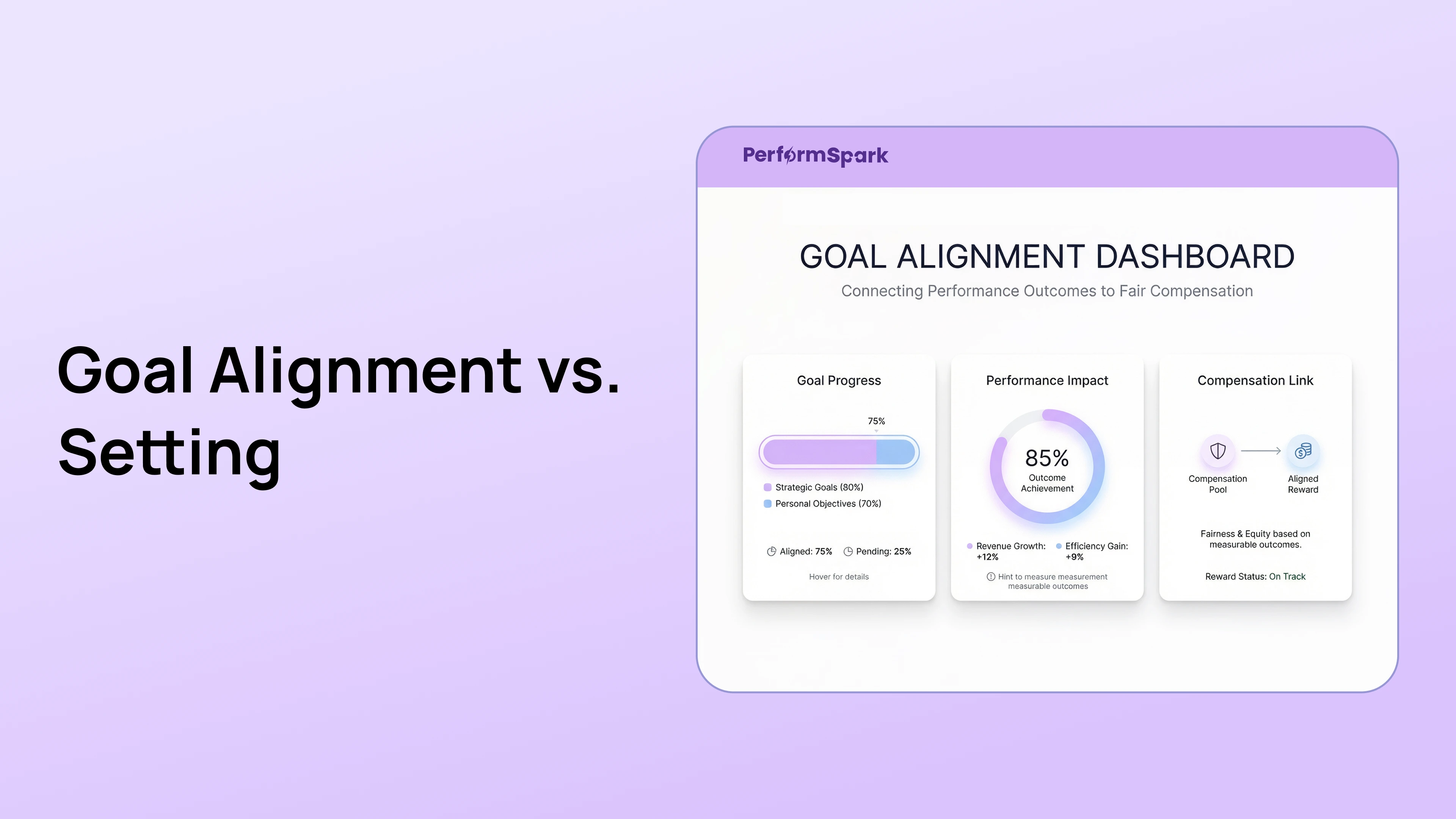
Goal Alignment vs. Setting: Connecting Performance Outcomes to Fair Compensation
In most organizations, Goal Setting is a seasonal ritual. Every January, employees are asked to fill out a form with three to five objectives. They spend hours crafting SMART definitions, get manager approval, and then the goals sit in a database untouched until December.
This is Goal Setting. It is an administrative task that checks a box for HR.
Goal Alignment is entirely different. It is a dynamic state where an employee's daily work is visibly connected to the company's strategic vision and directly linked to their future compensation.
For HR leaders and managers, the confusion between these two concepts is the root cause of the Execution Gap. When employees feel that their goals are just extra paperwork rather than the roadmap to their bonus, performance drops.
This guide explores how to transition your organization from a static to a dynamic alignment. We will examine how to utilize the PerformSpark Strategy to ensure that every goal written contributes to the Golden Thread of data that ultimately drives fair pay.
What is the difference between goal setting and goal alignment?
Goal Setting is the input activity of writing objectives, while Goal Alignment is the strategic architecture that connects those objectives to business outcomes. To fix the broken performance process, we must distinguish between the two.
Goal Setting (The Admin Task)
- Activity: Writing text in a digital form.
- Focus: Syntax and formatting. Users worry if the goal is Specific and Measurable.
- Outcome: A static document that is rarely opened.
Goal Alignment (The Strategy)
- Activity: Linking dependencies between roles and departments.
- Focus: Strategy and impact. Users ask if this goal supports the North Star metric of the company.
- Outcome: A unified direction where every employee understands their contribution.
The PerformSpark Difference: We do not just give you a text box to write goals. We provide the architecture to align them. Using the "W-Model" discussed in our Performance Management Blueprint, we allow leadership to set the strategic themes from the top down, while teams define the specific tactics from the bottom up. This creates a perfect W shape of alignment.
Why do traditional goal-setting frameworks fail?
The "Set and Forget" epidemic is a design problem, not a discipline problem. Traditional frameworks like MBOs (Management by Objectives) often fail because they lack three critical elements required for the modern workforce.
What is the Line of Sight problem?
Most individual goals are isolated. An engineer writes "Refactor Codebase," but they cannot see how that connects to the CEO's goal of "Increase Market Share." Without this Line of Sight, the work feels meaningless.
The Fix: You need a Cascading Goals system where users can visually trace their objective up to the parent goal. When an employee sees that their code directly impacts the company's bottom line, engagement increases significantly.
Why is annual tracking insufficient?
A "Dead" goal is updated once a year. A "Living" goal is updated weekly. Research shows that companies that review goals quarterly outpace those that review annually by 30 percent. Those who review weekly dominate their industries.
The Fix: Goals must be integrated into your weekly workflow. If you have to open a separate tab to update a goal, it will not happen. It must be part of the weekly ritual.
Should goals determine compensation?
This is the most controversial point in performance management. Many modern HR philosophies suggest separating goals from pay to encourage risk-taking. We disagree with this separation. If hitting a goal does not result in a reward, high performers stop hitting goals.
The Fix: You need a Calibration Engine that ingests goal achievement data to inform bonus payouts without dictating them robotically.
How does the Golden Thread connect goals to pay?
In our previous guide on the PerformSpark Strategy, we introduced the concept of the Golden Thread, which is a single data stream connecting all HR actions. Goal Alignment is the starting point of this thread. If a goal is misaligned at the start of the year, the downstream effects are catastrophic for the entire employee lifecycle.
1. The Learning Gap
If the goal is vague, the Individual Development Plan (IDP) cannot suggest relevant training. A goal like "Sell more" provides no data for learning recommendations. A goal like "Close 5 Enterprise Deals" triggers specific negotiation training.
2. The Check-in Gap
If the goal is irrelevant to daily work, weekly check-ins become status updates rather than coaching sessions. Managers stop asking about the goal because it does not reflect reality.
3. The Pay Gap
If the goal data is messy or incomplete, you cannot use it for Compensation Calibration. This forces you to rely on subjective manager bias when deciding raises, which leads to inequity and legal risk.
Therefore, Goal Alignment is not just an HR activity. It is a Data Integrity activity.
How does TrAI ensure goal quality?
The adage "Garbage In, Garbage Out" applies perfectly to performance management. If an employee writes a vague goal in January like "Get better at sales," the entire year of data is compromised. You cannot calibrate "Get better." You cannot compensate it fairly.
In the past, fixing these goals required managers to spend hours editing text. Today, TrAI (our ethical intelligence engine) solves the Goal Quality problem instantly.\
How does TrAI act as a goal coach?
TrAI does not just auto-complete sentences. It analyzes the intent and structure of the goal against best practices to ensure measurability.
The Clarity Score: As an employee types a goal into the Goals Management Software, TrAI assigns a real-time quality score from 0 to 100. If the goal lacks a metric or a deadline, the score remains red.
The Nudge: TrAI provides specific suggestions. For example, if a user types "Improve code quality,"
TrAI will suggest: "Consider changing this to 'Reduce post deployment bugs by 15% by Q3'." This ensures that every goal entering the system is measurable, trackable, and calibration-ready.
While Align happens in Q1 and Achieve happens in Q4, the magic happens in the Track phase. This is the operational rhythm that connects performance to reality.
What is the ATA Model for goal tracking?
Goal setting is useless without goal tracking. At PerformSpark, we replace the "Set and Forget" method with the ATA Model, which stands for Align, Track, Achieve.
Why is weekly tracking superior to quarterly reviews?
Most systems fail because they treat goal updates as a separate administrative burden. The ATA Model embeds goal tracking into the Weekly Check-in.
The Workflow: When a user logs their weekly check-in, their active goals appear on the side of the screen. They simply move a slider or update a number (e.g., Sales closed: $10k).
The Telemetry: This generates 52 data points on goal progress throughout the year. Managers know instantly if a goal is "At Risk" in February, rather than finding out in December when it is too late to fix.
How does goal alignment drive fair compensation?
The most sensitive moment in the employee lifecycle is the bonus payout. If an employee feels they worked hard but received a mediocre bonus, they disengage. If they see a low performer get the same raise as them, they quit.
The root of this unfairness is usually Subjectivity. Without data, pay decisions are based on who the manager likes most. Goal Alignment provides the antidote, which is Objectivity.
What is the role of calibration in compensation?
You cannot just hook a goal percentage to a bank account. That is too robotic and ignores nuance. Instead, you need Performance Calibration.
The Data View: In a calibration session, leaders see a Player Card for each employee. Thanks to the Golden Thread, this card displays the "Goal Achievement Rate" (e.g., 94%) right next to the manager's proposed rating.
The Conflict Check: If a manager tries to give a "Top Rating" to an employee who only hit 60% of their goals, the system flags the discrepancy.
The Result: Pay decisions are defensible. You can look an employee in the eye and say, "Your bonus is X because your goal achievement data showed Y."
How to calculate the ROI of goal alignment?
Investing in a Goal Management platform is not just about organizing text. It is about financial efficiency. When goals are misaligned, you are essentially paying salaries for work that does not matter.
What is the Drift Factor?
Consider the "Drift Factor." In many organizations, employees spend approximately 20% of their time on tasks that are not linked to the company strategy. These are often called Zombie Projects.
The Math: For a 500-person company with an average salary of $80k, a 20% waste equals **$8 Million per year** in lost productivity.
The PerformSpark Impact: By forcing a Line of Sight for every goal, you eliminate Zombie Projects. Every hour paid is an hour focused on the North Star.
Conclusion:
For too long, goal-setting has been treated as a January chore. It has been a box to check, so HR stops nagging.
But when you treat Goals as Telemetry, when you use TrAI to ensure quality, the ATA Model to ensure tracking, and Calibration to ensure fair pay, you transform the entire function of HR. You stop being the Police who enforce deadlines.
You become the Architect who aligns the workforce.
Don't settle for static text on a page. Demand a living ecosystem.
Book a Consultative Demo and see how PerformSpark turns Goal Setting into Business Results.
Goal Alignment vs. Setting: Connecting Performance Outcomes to Fair Compensation
In most organizations, Goal Setting is a seasonal ritual. Every January, employees are asked to fill out a form with three to five objectives. They spend hours crafting SMART definitions, get manager approval, and then the goals sit in a database untouched until December.
This is Goal Setting. It is an administrative task that checks a box for HR.
Goal Alignment is entirely different. It is a dynamic state where an employee's daily work is visibly connected to the company's strategic vision and directly linked to their future compensation.
For HR leaders and managers, the confusion between these two concepts is the root cause of the Execution Gap. When employees feel that their goals are just extra paperwork rather than the roadmap to their bonus, performance drops.
This guide explores how to transition your organization from a static to a dynamic alignment. We will examine how to utilize the PerformSpark Strategy to ensure that every goal written contributes to the Golden Thread of data that ultimately drives fair pay.
What is the difference between goal setting and goal alignment?
Goal Setting is the input activity of writing objectives, while Goal Alignment is the strategic architecture that connects those objectives to business outcomes. To fix the broken performance process, we must distinguish between the two.
Goal Setting (The Admin Task)
- Activity: Writing text in a digital form.
- Focus: Syntax and formatting. Users worry if the goal is Specific and Measurable.
- Outcome: A static document that is rarely opened.
Goal Alignment (The Strategy)
- Activity: Linking dependencies between roles and departments.
- Focus: Strategy and impact. Users ask if this goal supports the North Star metric of the company.
- Outcome: A unified direction where every employee understands their contribution.
The PerformSpark Difference: We do not just give you a text box to write goals. We provide the architecture to align them. Using the "W-Model" discussed in our Performance Management Blueprint, we allow leadership to set the strategic themes from the top down, while teams define the specific tactics from the bottom up. This creates a perfect W shape of alignment.
Why do traditional goal-setting frameworks fail?
The "Set and Forget" epidemic is a design problem, not a discipline problem. Traditional frameworks like MBOs (Management by Objectives) often fail because they lack three critical elements required for the modern workforce.
What is the Line of Sight problem?
Most individual goals are isolated. An engineer writes "Refactor Codebase," but they cannot see how that connects to the CEO's goal of "Increase Market Share." Without this Line of Sight, the work feels meaningless.
The Fix: You need a Cascading Goals system where users can visually trace their objective up to the parent goal. When an employee sees that their code directly impacts the company's bottom line, engagement increases significantly.
Why is annual tracking insufficient?
A "Dead" goal is updated once a year. A "Living" goal is updated weekly. Research shows that companies that review goals quarterly outpace those that review annually by 30 percent. Those who review weekly dominate their industries.
The Fix: Goals must be integrated into your weekly workflow. If you have to open a separate tab to update a goal, it will not happen. It must be part of the weekly ritual.
Should goals determine compensation?
This is the most controversial point in performance management. Many modern HR philosophies suggest separating goals from pay to encourage risk-taking. We disagree with this separation. If hitting a goal does not result in a reward, high performers stop hitting goals.
The Fix: You need a Calibration Engine that ingests goal achievement data to inform bonus payouts without dictating them robotically.
How does the Golden Thread connect goals to pay?
In our previous guide on the PerformSpark Strategy, we introduced the concept of the Golden Thread, which is a single data stream connecting all HR actions. Goal Alignment is the starting point of this thread. If a goal is misaligned at the start of the year, the downstream effects are catastrophic for the entire employee lifecycle.
1. The Learning Gap
If the goal is vague, the Individual Development Plan (IDP) cannot suggest relevant training. A goal like "Sell more" provides no data for learning recommendations. A goal like "Close 5 Enterprise Deals" triggers specific negotiation training.
2. The Check-in Gap
If the goal is irrelevant to daily work, weekly check-ins become status updates rather than coaching sessions. Managers stop asking about the goal because it does not reflect reality.
3. The Pay Gap
If the goal data is messy or incomplete, you cannot use it for Compensation Calibration. This forces you to rely on subjective manager bias when deciding raises, which leads to inequity and legal risk.
Therefore, Goal Alignment is not just an HR activity. It is a Data Integrity activity.
How does TrAI ensure goal quality?
The adage "Garbage In, Garbage Out" applies perfectly to performance management. If an employee writes a vague goal in January like "Get better at sales," the entire year of data is compromised. You cannot calibrate "Get better." You cannot compensate it fairly.
In the past, fixing these goals required managers to spend hours editing text. Today, TrAI (our ethical intelligence engine) solves the Goal Quality problem instantly.\
How does TrAI act as a goal coach?
TrAI does not just auto-complete sentences. It analyzes the intent and structure of the goal against best practices to ensure measurability.
The Clarity Score: As an employee types a goal into the Goals Management Software, TrAI assigns a real-time quality score from 0 to 100. If the goal lacks a metric or a deadline, the score remains red.
The Nudge: TrAI provides specific suggestions. For example, if a user types "Improve code quality,"
TrAI will suggest: "Consider changing this to 'Reduce post deployment bugs by 15% by Q3'." This ensures that every goal entering the system is measurable, trackable, and calibration-ready.
While Align happens in Q1 and Achieve happens in Q4, the magic happens in the Track phase. This is the operational rhythm that connects performance to reality.
What is the ATA Model for goal tracking?
Goal setting is useless without goal tracking. At PerformSpark, we replace the "Set and Forget" method with the ATA Model, which stands for Align, Track, Achieve.
Why is weekly tracking superior to quarterly reviews?
Most systems fail because they treat goal updates as a separate administrative burden. The ATA Model embeds goal tracking into the Weekly Check-in.
The Workflow: When a user logs their weekly check-in, their active goals appear on the side of the screen. They simply move a slider or update a number (e.g., Sales closed: $10k).
The Telemetry: This generates 52 data points on goal progress throughout the year. Managers know instantly if a goal is "At Risk" in February, rather than finding out in December when it is too late to fix.
How does goal alignment drive fair compensation?
The most sensitive moment in the employee lifecycle is the bonus payout. If an employee feels they worked hard but received a mediocre bonus, they disengage. If they see a low performer get the same raise as them, they quit.
The root of this unfairness is usually Subjectivity. Without data, pay decisions are based on who the manager likes most. Goal Alignment provides the antidote, which is Objectivity.
What is the role of calibration in compensation?
You cannot just hook a goal percentage to a bank account. That is too robotic and ignores nuance. Instead, you need Performance Calibration.
The Data View: In a calibration session, leaders see a Player Card for each employee. Thanks to the Golden Thread, this card displays the "Goal Achievement Rate" (e.g., 94%) right next to the manager's proposed rating.
The Conflict Check: If a manager tries to give a "Top Rating" to an employee who only hit 60% of their goals, the system flags the discrepancy.
The Result: Pay decisions are defensible. You can look an employee in the eye and say, "Your bonus is X because your goal achievement data showed Y."
How to calculate the ROI of goal alignment?
Investing in a Goal Management platform is not just about organizing text. It is about financial efficiency. When goals are misaligned, you are essentially paying salaries for work that does not matter.
What is the Drift Factor?
Consider the "Drift Factor." In many organizations, employees spend approximately 20% of their time on tasks that are not linked to the company strategy. These are often called Zombie Projects.
The Math: For a 500-person company with an average salary of $80k, a 20% waste equals **$8 Million per year** in lost productivity.
The PerformSpark Impact: By forcing a Line of Sight for every goal, you eliminate Zombie Projects. Every hour paid is an hour focused on the North Star.
Conclusion:
For too long, goal-setting has been treated as a January chore. It has been a box to check, so HR stops nagging.
But when you treat Goals as Telemetry, when you use TrAI to ensure quality, the ATA Model to ensure tracking, and Calibration to ensure fair pay, you transform the entire function of HR. You stop being the Police who enforce deadlines.
You become the Architect who aligns the workforce.
Don't settle for static text on a page. Demand a living ecosystem.
Book a Consultative Demo and see how PerformSpark turns Goal Setting into Business Results.




.svg)

.svg)
.svg)